
Customers & Workload
Are your best-paying clients actually your best clients?
The customer who brings in the most money isn't always the one who is best for your business. Learn how to spot the hidden costs in client relationships — and what to do about them.
About 8 minutes Free Google Sheets toolBy Tahirah
Jump to a section
Why score your clients?
Have you ever finished dealing with a customer and thought, “That was far more work than it should have been”?
Perhaps they're always asking for little extras. They take ages to approve anything but expect you to reply immediately. Or you're forever chasing invoices and explaining the same thing twice.
Yet when you look at what they spend with you, they're one of your biggest customers. So you put up with it.
It's easy to judge a client by how much they pay. But that doesn't tell you how much time, energy and money it takes to look after them.
More revenue doesn't always mean more profit — or a healthier working relationship.
Get a clearer picture
Compare several aspects of a relationship, not just the invoice total.
Have better conversations
Use specific examples instead of relying on frustration.
Make more informed decisions
See where a practical change could improve the relationship.
Here's a simple example
Two fictional customers. Same business, different demands on your time.
Customer A
£3,000
Project revenue
- Time spent
- 60 hours
- Time cost (£30/hr)
- £1,800
- Other direct costs
- £700
- Amount left
- £500
Customer B
£2,000
Project revenue
- Time spent
- 20 hours
- Time cost (£30/hr)
- £600
- Other direct costs
- £200
- Amount left
- £1,200
Illustrative figures only, before general business overheads and tax. Your actual hourly cost will be different. Customer A isn't automatically a bad client: pricing, scope or the way work is delivered might need adjusting.
The five things to check
Client scoring means giving each customer a simple rating across a few practical areas. It turns “this customer is hard work” into something you can look at properly.
01 / 5
Payment reliability
Do they pay to agreed terms, or is someone always chasing invoices?
Ask yourself: How much effort goes into getting paid?
02 / 5
Communication
Are instructions clear and decisions timely, or does work stall while you wait?
Ask yourself: Does information move the job forward?
03 / 5
Boundaries
Do they respect agreed scope, working hours and processes? Questions and reasonable changes are fine; constant unagreed extras are different.
Ask yourself: Are we regularly giving more than we agreed?
04 / 5
Profitability
Once you account for staff time, supplier costs and other direct expenses, is the work financially worthwhile?
Ask yourself: What is actually left after delivering the work?
05 / 5
Long-term fit
Is this relationship sustainable and right for the business you're building? A stable client can be valuable even if they never increase their spending.
Ask yourself: Would we be happy to continue working together?
How the scorecard works
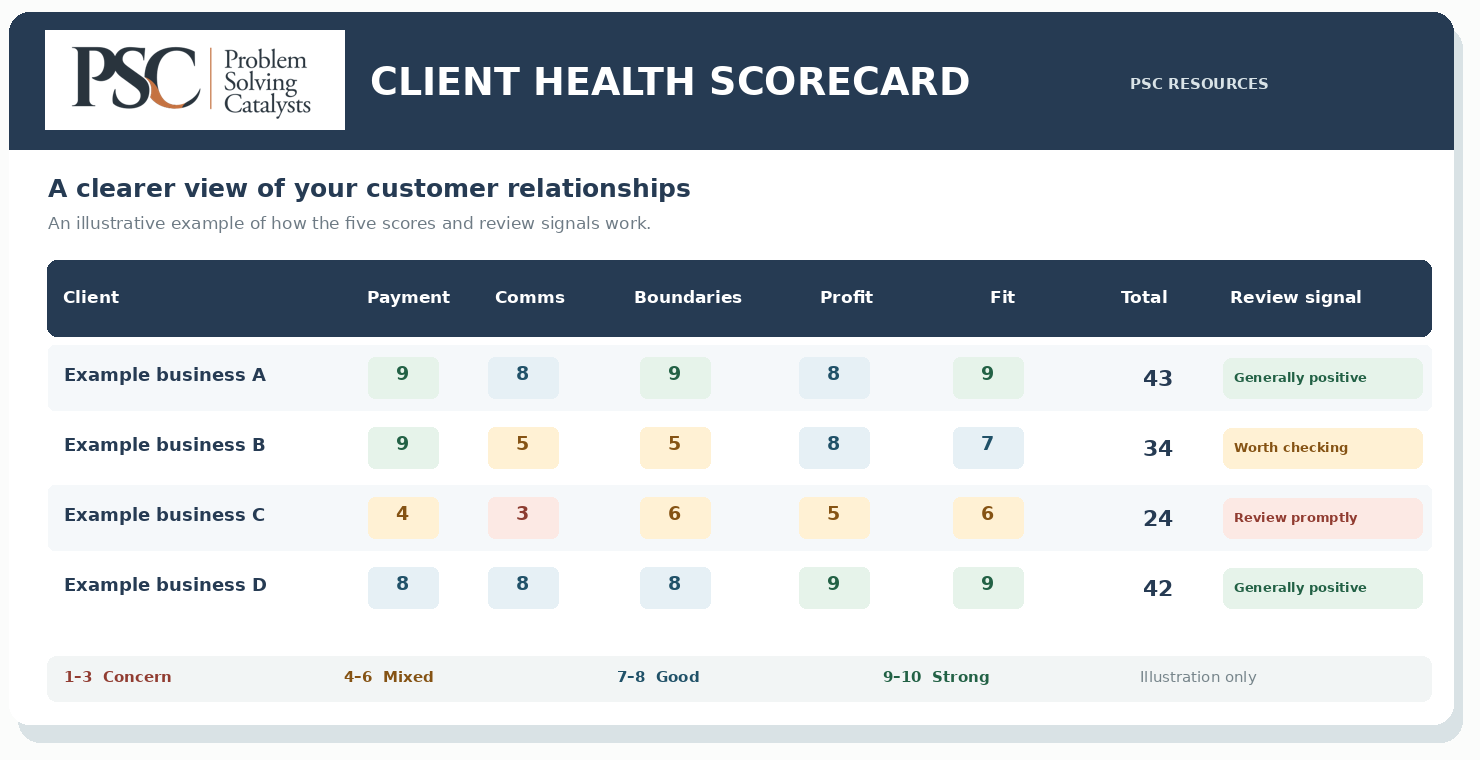
The scorecard gives you one row per customer. You choose five scores, add a short note and let the spreadsheet calculate the total and highlight anything worth reviewing.
- 1–3Serious or recurring concern
- 4–6Mixed — something may need improving
- 7–8Generally working well
- 9–10Consistently strong
Make a copy
Open your own editable Google Sheet.
Score each client
Pick 1–10 in five dropdowns.
Review the result
See totals and areas to investigate.
Choose an action
Add a note and next review date.
When to review
You don't need to do this every week. The point is to notice changes and act where it matters — not create another administrative job.
When you first start
Review five regular or significant clients so you have a useful starting picture.
Every three months
For key ongoing accounts, see whether the relationship has improved or become harder.
After a significant problem
Revisit the scores when you have enough facts to understand what happened.
After you change something
Check whether your pricing, handovers or agreed processes are working better.
These are suggested review points, not fixed rules. A business with a few large clients will use the tool differently from one handling hundreds of small transactions.
What to do with results
This is where the tool becomes useful. A low score shouldn't automatically tell you to drop a customer. It should help you ask why the issue keeps happening.
Example A · Communication
Decisions keep getting delayed. Are requests going to different people? Do customers know who needs to approve work? Is there one place to check the latest decision? Possible improvement: agree one contact person or a clearer approval process.
Example B · Profitability
Extra work keeps creeping in. Are you underestimating delivery time, offering too many extras or not recording the actual costs of a job? Possible improvement: clarify scope, track effort or revisit how you price the service.
And if several clients are experiencing the same issue, perhaps the problem is in your own process rather than with them. That's an important finding too.
How AI can help
You don't need AI to do the scoring. The spreadsheet calculates the results for you. But an AI assistant can help you organise your thoughts and work out useful questions to ask next.
Spot patterns in the notes you've written.
Suggest possible causes without blaming the customer.
Prepare questions for a review meeting.
Draft a polite email about scope or late information.
Turn a problem into a short action plan.
Give AI a specific task. Don't ask it to decide whether a customer deserves to stay.
Example prompt · copy and adapt
I'm reviewing one of my customer relationships.
Payment reliability: [1–10]
Communication: [1–10]
Boundaries: [1–10]
Profitability: [1–10]
Long-term fit: [1–10]
Here are brief, non-identifying observations:
[Describe the relevant issues without private details.]
Please help me:
1. Identify two areas worth investigating.
2. Suggest possible causes, without assuming the customer is to blame.
3. Suggest three practical improvements.
4. Give me questions to ask before deciding.
Use plain English. Separate facts from guesses.
Don't recommend ending the relationship based on a numerical score alone.
Start with five clients
Choose five customers you work with regularly. Give each a rating in the five areas, write down the reason for any unusually low score and look for patterns.
Then ask one question: “What is one change we could make that would improve these relationships?”
It might be a clearer quote, a better handover, a scheduled check-in or a simpler way to manage customer requests. Small changes can make a meaningful difference when they address the right problem.
Ready to see the full picture?
Get the free PSC Client Health Scorecard. Copy it into your own Google Drive and start assessing customer relationships more thoughtfully.